
B Cell-Based Biomarker for Detecting Acute Renal Transplant Rejection
University of Pittsburgh researchers have developed a novel blood test that accurately identifies acute renal transplant rejection, including subclinical rejection. This biomarker is based on the simultaneous analysis of multiple cell surface markers on peripheral blood B cells using spectral flow cytometry. The innovative approach leverages machine learning algorithms to differentiate between patients with acute rejection (AR) and those without rejection (NR), offering a highly sensitive and specific diagnostic tool with both a high negative and positive predictive values.

Description
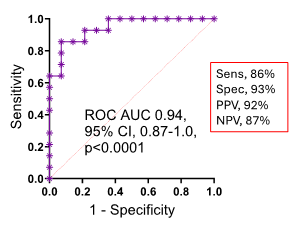
Given the low incidence of subclinical rejection, biomarkers inherently have a high NPV. Unfortunately, most biomarkers also have poor PPVs, making them only marginally better at predicting subclinical rejection than clinical impression. Further, only ~60% of indication biopsies, actually exhibit renal allograft rejection. This new biomarker uses simultaneous analysis of multiple surface markers on peripheral blood B cells displayed as t-SNE plots to identify distinct B cell subpopulations present in settings of acute rejection (AR) versus no rejection (NR). In a study of 28 patients undergoing surveillance biopsies, this method accurately differentiated subclinical AR and NR with PPV (92%), NPV (87%), sensitivity (86%) and specificity (93%). Thus, this biomarker can detect patients with acute rejection, subclinical rejection, and potentially identify unresolved rejection, reducing the need for invasive biopsies.Applications
• Detection of acute renal transplant rejection• Monitoring subclinical rejection
• Reducing the need for invasive surveillance biopsies
• Potentially identifying resolved rejection
Advantages
This biomarker provides a noninvasive method to accurately detect acute renal transplant rejection, including subclinical cases. The high PPV and NPV identifies patients who are likely to have or not have AR, reducing the need for invasive biopsies, improving patient care and reducing healthcare costs. The use of spectral flow cytometry and machine learning algorithms ensures precise and reliable results, making this biomarker a valuable tool in transplant medicine.Invention Readiness
The concept has been defined and validated through in vivo studies, with prototype performance demonstrating high accuracy in detecting acute renal transplant rejection. Ongoing research aims to prospectively test more patients prospectively and explore the biomarker's potential to identify borderline rejection and infections such as BK or CMV.IP Status
https://patents.google.com/patent/WO2025165945A1Related Publication(s)
Cherukuri, A., Salama, A. D., Mehta, R., Mohib, K., Zheng, L., Magee, C., Harber, M., Stauss, H., Baker, R. J., Tevar, A., Landsittel, D., Lakkis, F. G., Hariharan, S., & Rothstein, D. M. (2021). Transitional B cell cytokines predict renal allograft outcomes. Science Translational Medicine, 13(582). https://doi.org/10.1126/scitranslmed.abe4929