
Enhanced Oil Recovery from Shale Using CO2 and Surfactant Solutions
University of Pittsburgh researchers have developed a novel process to enhance oil recovery from shale formations using a high-pressure single-phase solution of CO2 and CO2-soluble surfactants. This method leverages both the solvent properties of CO2 and the wettability-altering characteristics of surfactants, providing a more efficient way to extract oil from unconventional shale formations. This innovative approach could significantly increase oil recovery while reducing the environmental impact associated with traditional extraction methods.
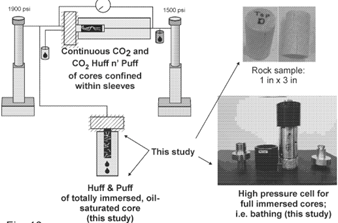
Description
This process involves injecting a high-pressure solution of CO2 containing a dilute concentration of CO2-soluble surfactants (typically nonionic) into fractured shale formations. The CO2 acts as a solvent for the oil, reducing its viscosity and swelling it to facilitate extraction. Meanwhile, the surfactant adsorbs onto the shale, making it more water-wet, which further aids in displacing the oil. Unlike traditional methods that rely solely on CO2 or surfactant injection separately, this combined solution provides dual benefits, enhancing oil recovery efficiency. The technology can be used during the fracturing process or in post-fracture recovery, as well as in various CO2 injection modes (continuous, cyclic, huff 'n puff).Applications
- Enhanced oil recovery (EOR) from shale formations (e.g., Bakken formation)- CO2 injection for oil recovery
- Fracturing process enhancement