
IRF-2-expressing Oncolytic Vaccinia Virus for Cancer Therapy
Several immunotherapy protocols, such as immune checkpoint blockade (ICB) with antibodies, have seen significant success in recent years. However, it is clear that these therapies as single modalities or even in combination with each other are only effective for a subset of patients. Additionally, there is growing literature indicating the development of ICB resistance in patients who were previously responsive.
Description
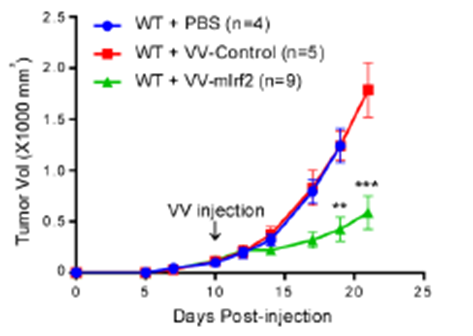
A major determining factor of both response to ICB and development of ICB resistance is the Interferon (IFN) response in the tumor microenvironment (TME). IFNs appear to play opposing roles in tumor cells compared to immune cells. Researchers have used this opposing IFN response by modulating the transcription factors that regulate IFN response to improve immunotherapy by using a series of CRISPR/Cas9-based gene-edited syngeneic tumor cells to establish that tumor-intrinsic functions of specific IFN regulatory factors (IRFs) may underlie the opposing IFN response in tumor cells. A new IRF2-based transcriptional modifier that modulates IRF function in the TME using an engineered oncolytic virus has shown success in preclinical mouse models by forcing IRF2 expression in tumors by modulating IFN response and promoting a positive response to ICB. This is a conceptually new approach to tumor therapy using existing technology.Applications
• Immunotherapy for cancerAdvantages
• Uses a well-known oncolytic Vaccinia virus vehicle• Reduces risk of developing resistance to ICB therapy
• Promotes a positive response to ICB therapy