
Novel Salivary Biomarker for Cognitive Impairment
University of Pittsburgh researchers have identified a novel biomarker, sTREM2 protein, in saliva samples that can be used as a marker of cognitive impairment. This novel marker, obtainable from non-invasive saliva sampling, could dramatically improve early diagnosis of cognitive impairment, inform clinical decisions and ultimately improve patient outcomes through early diagnosis and treatment.
Description
Millions of Americans are living with some form of dementia, the most common being Alzheimer’s disease (AD). Dementia not only impacts on the patient with key signs including personality changes, cognitive impairment and difficulty with complex tasks all impacting on daily life, but AD also affects caregivers, friends, and family who must watch the decline of a loved one. Changes to underlying brain pathology (e.g., accumulation of amyloid beta plaques and phosphorylated tau neurofibrillary tangles) begin over a decade prior to onset of symptoms and neuroinflammation is a key contributor to dementia. This novel biomarker of neuroinflammation, sTREM2, could allow for earlier detection of cognitive impairment before irreversible changes in brain pathology. Timely detection could result in earlier, more targeted treatment of patients, potentially delaying the onset of dementia and further cognitive decline.Applications
- Alzheimer’s disease- Vascular dementia
- Lewy body dementia
Advantages
The triggering receptor expressed on myeloid cells 2 (TREM2) is a transmembrane receptor with an immunoregulatory role. Soluble TREM2 (sTREM2), has previously been detected in cerebrospinal fluid (CSF) samples from patients with cognitive impairments and is associated with neuroimmune activity and neurodegenerative pathophysiology. However, CSF collection requires a highly invasive spinal puncture making it unsuitable for use in community settings or large-scale screening.This novel approach uses saliva samples allowing for less invasive and scalable screening for the presence of sTREM2, a marker of neuroinflammation in patients with cognitive impairment. Early identification of neuroinflammation can inform treatment decisions potentially reducing neuroinflammation and preventing the changes to brain pathology associated with dementia.
Invention Readiness
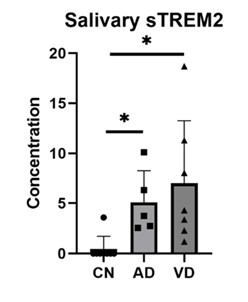
Saliva samples from cognitively unimpaired controls (n=8), patients diagnosed with AD (n=5) and patients diagnosed with vascular cognitive impairment (n=7) were collected and analysed for sTREM2 levels. Not only were sTREM2 levels successfully determined in saliva, but patients with AD or VD exhibited significantly higher levels than CN samples suggesting sTREM2 is a viable biomarker for the early detection of dementia. Further research and validation of this biomarker is required.IP Status
Patent PendingRelated Publication(s)
Pascoal, T. A., Aguzzoli, C. S., Lussier, F. Z., Crivelli, L., Suemoto, C. K., Fortea, J., Rosa-Neto, P., Zimmer, E. R., Ferreira, P. C. L., & Bellaver, B. (2024). Insights into the use of biomarkers in clinical trials in Alzheimer’s disease. EBioMedicine, 105322–105322. https://doi.org/10.1016/j.ebiom.2024.105322
Zeng, X., Lafferty, T. K., Sehrawat, A., Chen, Y., Ferreira, P. C. L., Bellaver, B., Povala, G., Kamboh, M. I., Klunk, W. E., Cohen, A. D., Lopez, O. L., Ikonomovic, M. D., Pascoal, T. A., Ganguli, M., Villemagne, V. L., Snitz, B. E., & Karikari, T. K. (2024). Multi-analyte proteomic analysis identifies blood-based neuroinflammation, cerebrovascular and synaptic biomarkers in preclinical Alzheimer's disease. medRxiv : the preprint server for health sciences, 2024.06.15.24308975. https://doi.org/10.1101/2024.06.15.24308975