
Precision PET Image Enhancement
This innovation is a novel post-processing software designed to significantly enhance the quality of Positron Emission Tomography (PET) scans by effectively removing noise. It enables the early visualization of critical disease features such as lesions and protein aggregations, directly improving the speed and accuracy of clinical diagnoses for chronic conditions like Alzheimer’s disease.
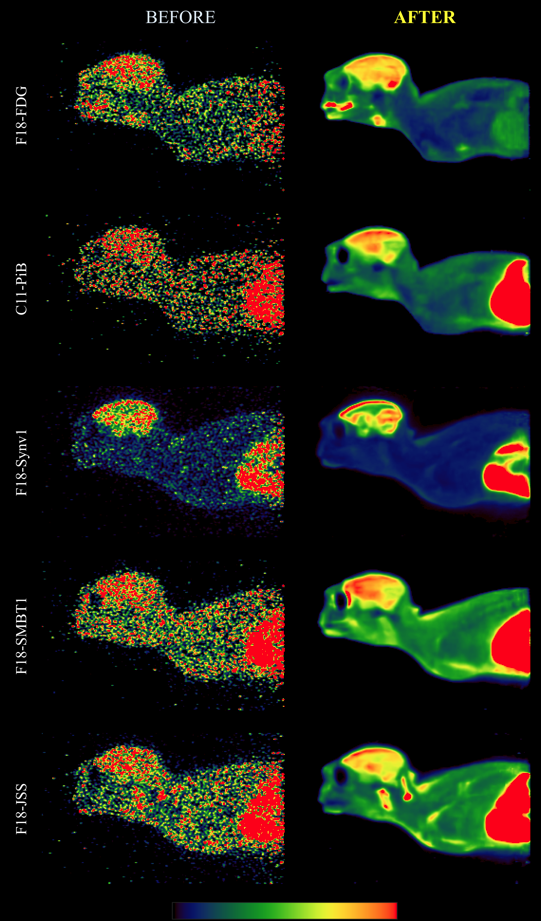
Description
The technology utilizes a sophisticated algorithm to address the poor image quality typically associated with PET imaging. By reconstructing PET data, the software characterizes and eliminates noise more effectively than existing methods. This denoising process results in images with higher anatomical specificity and clarity. Unlike traditional visualization methods that rely on smoothing or spline interpolation, which can introduce diagnostic uncertainty; this method provides a clearer view of raw data, allowing for the reliable identification of positive diagnostic signals that might otherwise be obscured by noise.Applications
- Pharmaceutical Development: Assisting companies in developing new treatments and revisiting clinical trials to reclassify subjects with higher precision.- Medical Imaging Equipment: Integration into the software suites of PET imaging scanner vendors to improve diagnostic capabilities.
- Clinical Diagnostics: Providing PET imaging service providers and physicians with tools for faster, more accurate patient throughput and early-stage treatment planning.
- Oncology: Application of the denoising method to cancer imaging to improve lesion detection and monitoring.
- Neuroimaging Research: Enhancing datasets for research into Alzheimer's and other neurodegenerative diseases.
Advantages
- Superior Image Clarity: Effectively eliminates noise contamination to provide clearer, more accurate images than current solutions.- Enhanced Early Diagnosis: Improves the early detection of disease features, which is decisive for the success of treatments for conditions like Alzheimer’s.
- Universal Compatibility: Requires no additional hardware infrastructure and can be integrated with any commercially available PET scanner.
- Protocol Independent: The software pipeline is independent of specific imaging protocols or hardware upgrades, making it easy to implement.
- Retrospective Capability: Can be applied to previously acquired images, allowing for the re-analysis of existing data or past clinical trials.