
Remote and Controllable Drug Release System
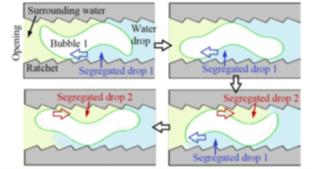
University of Pittsburgh researchers have developed a remote, dose-controllable drug delivery system for use in vitro or in vivo. This system consists of a microtube, sealed at one end with a rachet structure on the inner walls, and containing a liquid droplet sandwiched between two air bubbles. Acoustic oscillations can control the shape of these air bubbles leading to segregation and subsequent transport of the droplet contents along the microtube and into the surrounding environment (i.e., mass exchange) in a controlled manner. This novel method could be developed for use in an implantable microsystem to release medication in a controlled manner as part of a treatment plan.
Description
Depending on need, many pharmaceutical drugs should be administered in a pulsatile or a continuous manner. Traditionally, this has been through delivery routes including oral administration, inhalation, hypodermic or transdermal injection. These methods often result in systemic administration, risking off-target adverse effects and requiring large dosages being administered to account for metabolic losses. Developing a drug delivery system that can deliver directly to the organ or tissue of interest would allow for more targeted treatment. This novel drug delivery system could be implanted in the body, does not require a power supply and could be remotely controlled to administer therapeutic agents as needed.Applications
- In vitro drug release devices- In vivo drug release devices
Advantages
Implantable microsystems for controlled drug release need to allow for continuous or pulsatile release depending on the therapeutic need. While microfluidic systems can fulfill this need, current systems require a power supply, limiting their use.In this novel approach, drug release is controlled by acoustically oscillating bubbles, removing the need for external power supply. This on-demand drug release system can be activated by an acoustic wave source outside the body. The system consists only of a microtube with a rachet structure on the internal surface, the angle of which can be modified for high control of the rate of mass exchange. Acoustic stimulation of the air bubbles only occurs within a narrow frequency window of 2.4–2.5 kHz, allowing for activation of the bubbles by the user as needed. The rate of drug release can be controlled by the duty cycle (i.e., fraction of “on” time over each cycle) and the number of cycles, e.g., a duty cycle at 12.5% requires 28 cycles to completely release the contents of the droplet compared to a duty cycle of 50% which needs 3 cycles.
Invention Readiness
A 3D printed microtube, sealed at one end, with rachet structure on the inner surface was produced. Testing using a drop with a dye and another with 20 μm plastic particles confirmed mass exchange from the tube to surrounding environment occurred at a stable rate controllable by external acoustic input. Pulsatile or continuous release are both possible.IP Status
https://patents.google.com/patent/US11975171B2Related Publication(s)
Liu, F.-W., & Cho, S. K. (2020). Acoustically Excited Micro Mass Transport for Remotely Dose-Controlable Drug Releasing. In 2020 IEEE 33rd International Conference on Micro Electro Mechanical Systems (MEMS) (pp. 1052–1055). 2020 IEEE 33rd International Conference on Micro Electro Mechanical Systems (MEMS). IEEE. https://doi.org/10.1109/mems46641.2020.9056218