
Acoustic Needle Sensing for Precision Cannulation and Real-time Tissue Identification
This invention is an acoustic sensing system for hypodermic needles that utilizes piezoelectric transducers to provide instantaneous feedback on needle state during medical procedures. By analyzing vibration modes, the system allows clinicians to accurately identify material types and penetration depth, significantly reducing first-attempt failure rates in procedures like intravenous catheterization.
Description
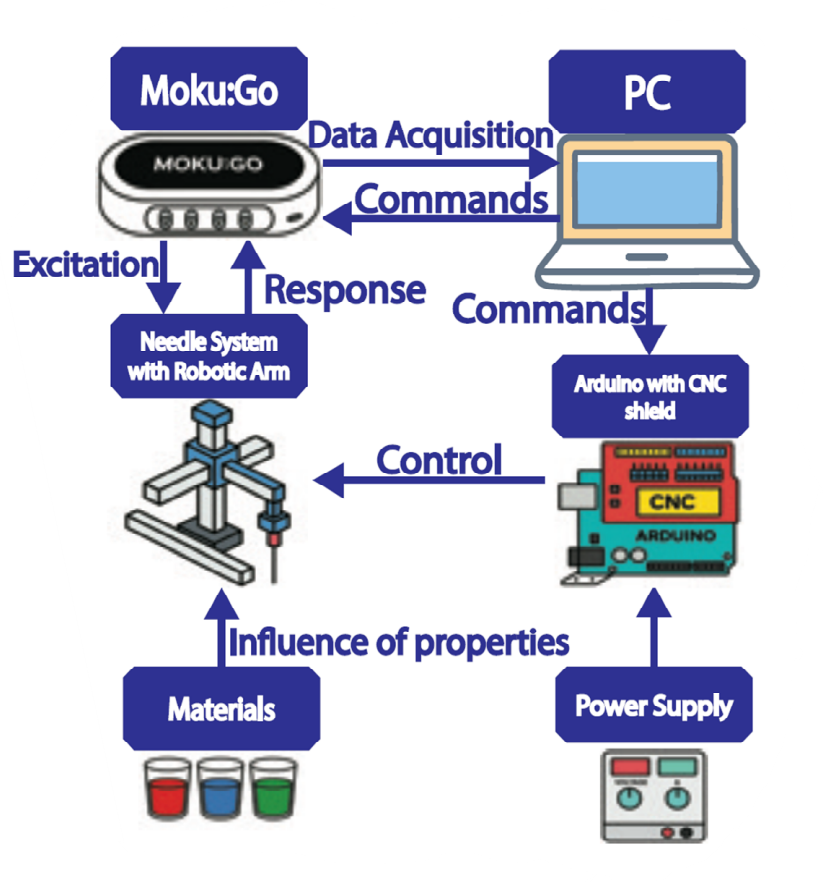
The system integrates two lead zirconate titanate (PZT) piezoelectric cylinders mounted onto a standard medical needle. A controller sends an excitation signal to the first transducer, causing it to deform and vibrate the needle cannula at a selected frequency. As the needle interacts with different materials, the second transducer acts as a deformation sensor, capturing changes in the needle’s longitudinal and torsional vibration modes.To ensure high accuracy, the system employs advanced machine learning algorithms to process the captured signals. It uses Proper Orthogonal Decomposition (POD) for time-domain signals and the Discrete Empirical Interpolation Method (DEIM) for frequency-domain signals to extract key features. These features are then analyzed by an artificial neural network to determine exactly when the needle tip enters a specific tissue or vessel, providing a low-cost, high-precision alternative to traditional tactile feedback or expensive imaging.
Applications
- Intravenous catheterization: Enhancing vein location accuracy to reduce first-attempt failure rates and patient discomfort.- Biopsy procedures: Providing precise needle placement within targeted tissues to improve sampling accuracy.
- Regional anesthesia: Assisting anesthesiologists in needle positioning for nerve blocks with real-time tissue identification.
- Minimally invasive surgeries: Enabling accurate needle insertion in delicate tissues to minimize trauma and procedural risks.
- Medical training and simulation: Offering objective feedback for clinicians to develop and refine needle insertion techniques.
Advantages
- High classification accuracy: Achieves tissue/material classification accuracies above 99%, significantly reducing erroneous needle placements.- Real-time feedback: Rapid signal processing allows immediate response during needle insertion, facilitating timely adjustments by clinicians.
- Non-invasive sensing capability: Utilizes acoustic vibrations transmitted through the needle, obviating the need for additional imaging or invasive sensing modalities.
- Enhanced procedural success: Reduces the likelihood of multiple insertion attempts, lowering patient discomfort, procedural time, and complication risks.
- Integration potential: The compact nature of piezoelectric sensors allows for seamless integration into existing needles without significant modification or cost increases.
- Robust analytical framework: Leveraging sophisticated machine learning techniques improves system adaptability across various clinical scenarios and tissue types.