This technology is a method of treating conditions linked to nuclear speckle sphericity by administering a nuclear speckle rejuvenator such as pyrvinium, including as an eye-directed preparation for retinitis pigmentosa. It offers a way to treat retinitis pigmentosa, including cases with the common RHO P23H mutation, and other proteinopathies by restoring the organization of nuclear speckles.
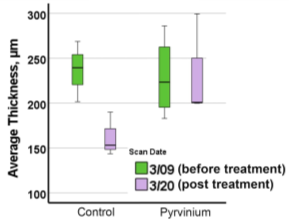
Pyrvinium, an FDA approved treatment for pinworm can restore retinal thickness in animal models of RP. Pyrvinium improves proteostasis through targeting NC LLPS through SON overexpression and could have applications in many proteinopathies.
Description
Nuclear speckles are structures in the cell nucleus that concentrate the factors needed to process messenger RNA. In proteinopathies, they can become overly round and compact. This technology uses a “nuclear speckle rejuvenator” that restores their normal structure and function, making them less spherical, more diffuse and better organized. It can also increase expression of the speckle scaffold proteins SON and SRRM2. The lead compound is pyrvinium, including pyrvinium pamoate, and its salts and derivatives.
Pyrvinium binds SON and lowers the surface tension of speckle condensates. This amplifies the cell’s protein quality control program and degradation pathways (the ubiquitin-proteasome system and autophagy) while dampening YAP1 signaling. In cell models, this reduced levels of the mutant RHO P23H protein, the most common cause of dominant retinitis pigmentosa. The compound can be formulated as an ophthalmic preparation for instillation, or as an intravitreal preparation, at concentrations from 10 nM to 10 µM, with 0.2–0.5 µM as a narrower range.
Applications
- Ophthalmic therapeutics for retinitis pigmentosa, including RHO-mutation (P23H) disease
- Intravitreal drug products for retinal degeneration
- Topical eye-drop (instillation) products for retinal disease
- Therapeutics for proteinopathies of the nervous system, including Alzheimer’s disease, Parkinson’s disease and frontotemporal dementia
- Pharmaceutical development of nuclear speckle rejuvenator compounds as a new drug class
Advantages
- Acts through nuclear speckle organization, an upstream regulator of protein quality control, rather than a single degradation pathway
- Applicable to retinitis pigmentosa, including patients with RHO gene mutations such as P23H
- Flexible ocular delivery by instillation or intravitreal administration
- Active in a defined, low concentration range (10 nM to 10 µM; 0.2–0.5 µM in narrower embodiments)
- Potential applicability across several proteinopathies (Alzheimer’s disease, Parkinson’s disease, frontotemporal dementia)
Invention Readiness
The technology is at the preclinical proof-of-concept stage. A screen identified pyrvinium pamoate as a speckle rejuvenator, and its dependence on SON, direct binding to SON and effects on speckle condensates were established in cells and cell-free systems. In cultured retinal explants from RHO P23H mice, treatment with 0.2–0.5 µM for 10 days preserved retinal thickness, volume and outer nuclear layer cell counts, with no noticeable toxicity. In cell models, treatment at 0.1 µM reduced mutant RHO P23H protein.
IP Status
https://patents.google.com/patent/WO2026033412A1Related Publication(s)
Dion, W., Tao, Y., Chambers, M., Zhao, S., Arbuckle, R. K., Sun, M., Kubra, S., Schaich, M. A., Nie, Y., Ye, M., Jamal, I., Larsen, M. B., Camarco, D., Ickes, E., Wang, H. H., DuPont, C., Wang, B., Liu, S., Pi, S., … Zhu, B. (2024). SON-dependent nuclear speckle rehabilitation alleviates proteinopathies. Cold Spring Harbor Laboratory. https://doi.org/10.1101/2024.04.18.590103


