If a hip does not seat properly early in life, it will not develop properly, leading to developmental dysplasia of the hip (DDH), which can cause abnormal gait, decreased strength, and a heightened risk of degenerative hip and knee joint diseases later in life. Approximately 1 out of 6 newborns will have some type of hip instability, and 2-3 out of every 1,000 infants will require surgical treatment. The procedure for corrective surgeries is unchanged in over 50 years, and complete or partial re-dislocations occur in even expert hands, leading to additional surgical procedures, prolonged immobilization, and suboptimal outcomes. Due to the high failure rate, many affected individuals forego treatment. Clearly, there is an unmet need for a more reliable hip reduction surgery to help increase success in restoring normal anatomy and function.
Description
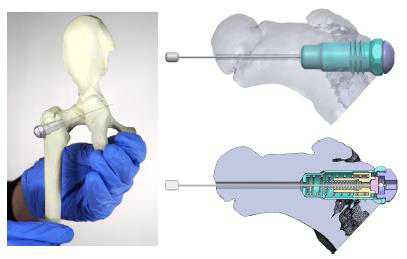
Current surgical technique involves tightening the ligamentum teres, a “tether” that stretches out and becomes a barrier to hip reduction. Tightening the tether is technically challenging. Researchers propose using a bio-resorbable suture-anchor implant device that would reproduce dynamic stabilization of the hip joint and enable the displaced hip to grow back together, offering the possibility of the original functionality. A novel reliable hip tether technique has the potential to improve surgical outcomes, decrease immobilization, decrease residual dysplasia, and limit the need for future constructive surgery, in addition to shortening the duration of hospital stay and reducing the costs for patients. The suture-anchor implant device can also be applied to shoulder or other joint tissue surgeries.
Applications
• Hip reduction surgery
• Traumatic hip injury surgery
• Surgery on the shoulder or other joints
Advantages
• Improves likelihood of a successful surgical outcome
• Reduces the rate of re-dislocation and limits the need for additional
surgeries
• May restore original functionality
• Higher success rate and lower cost makes surgery accessible for a
greater number of affected individuals
• Decreases immobilization and residual dysplasia
• Shortens duration of hospital stay
Invention Readiness
Prototype
IP Status
https://patents.google.com/patent/WO2020214726A1

